
Made by: Zapiain
Made in: Astigarraga, Basque Country
Style: Medium Dry
ABV: 6%
Carbonation: Still
Bought: Good Spirits Co. Wine & Beer, Glasgow
Price: £3 (37.5cl bottle)
Producer’s website: Zapiain
As it does in various places in northern France and Spain, cider has a special place in the culture of the Basque country. It’s so much more than just a tasty thirst-quencher and helps in many ways to define the region, particularly around San Sebastián where about 90% of the region’s cider comes from. Known locally as sagardoa (literal translation: apple wine), it’s a highly ritualised and almost fetishised drink to the Basques. And what’s not to like about a whole people that take cider drinking too seriously?
Most of the cider made in the region is made by the famous cider houses – sagardotegia – and among the most famous is Zapiain. The Basque Country, like France, takes its labelling and quality control much more seriously than we do in the UK when it comes to cider-making and operates two official quality labels: Euskal Sagardoa and Gorenak. The former deals with the origin of the fruit, the latter with quality.
If you’re interested in the fine detail, Google the two terms (other search engines are available) but basically the Euskal Sagardoa is sort of an AOC for Basque natural cider. It was created in 2017 and permits the use of about 115 local apple varieties grown in the Basque Autonomous Community. Qualifying ciders are also quality controlled and are, frankly, the best of the best.
Similarly, every bottle of cider wearing the Gorenak “txapela” top has to meet very strict quality analytics requirements and tasting panels and has obtained high qualifications by the Fraisoro Laboratory. Note, however, that to meet the Gorenak spec, apples needn’t be sourced locally – they can still be imported. It’s purely a quality guarantee.
In other words, these labels mean customers know what they’re getting when they buy the cider. Nice and honest and transparent. Wouldn’t it be nice to see something similar in the UK?
Anyway, enough of the backdrop, time for the star turn.
TASTING NOTES, AFTER A FASHION:
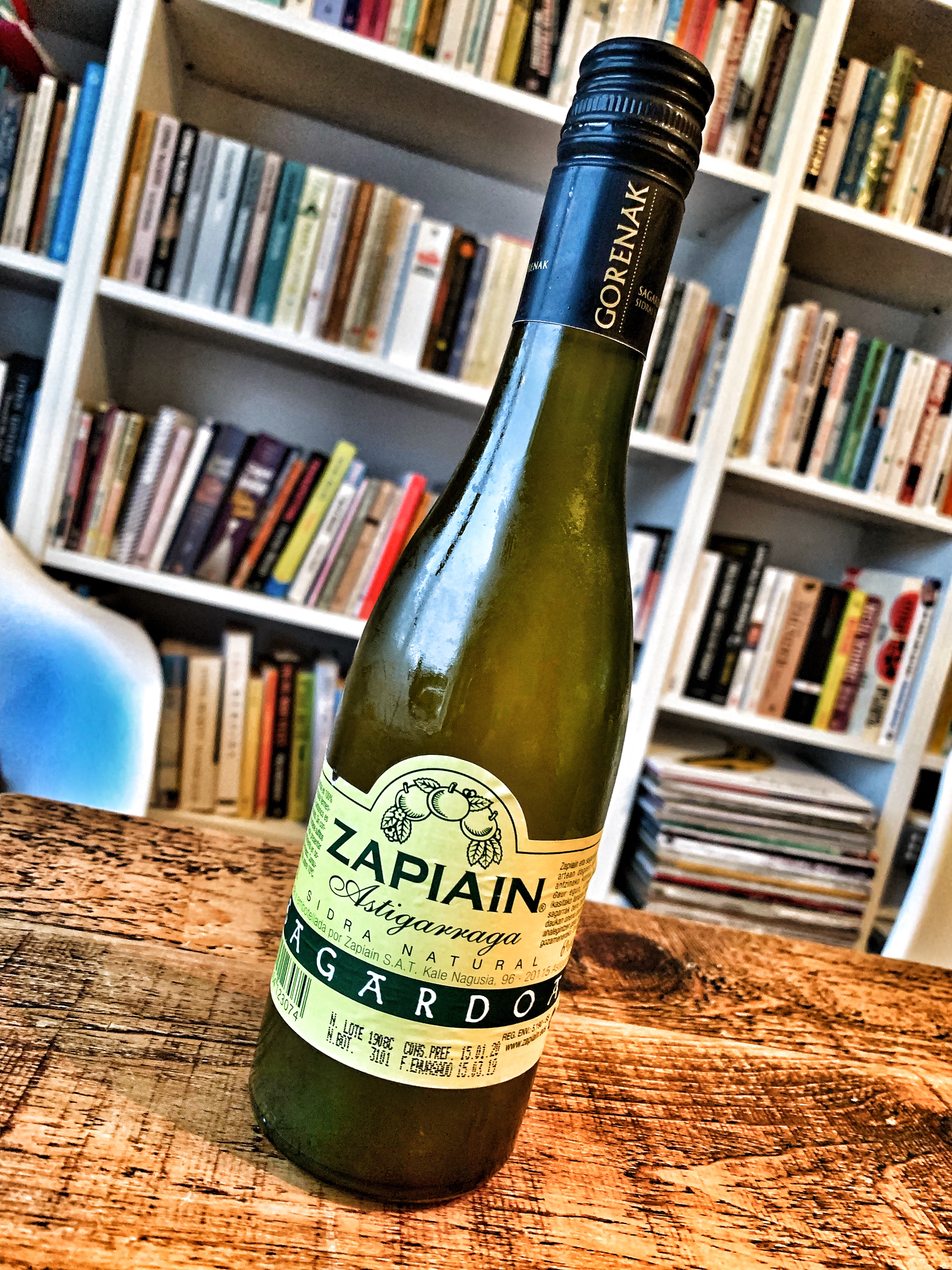
Reassuringly, the bottle I’m cracking open tonight does indeed carry the Gorenak neck label so I know I’m getting quality, although as it doesn’t have an Euskal Sagardoa badge I can be fairly certain it’s not made exclusively from Basque fruit – which is shame. I’ll know what to look for next time.
Made in Astigarraga, the very heart of Basque cider country, Zapiain’s sagardoa even comes with a wee date stamp telling me that it was made on the 15th of March 2019, which is a nice touch. It goes without saying that it’s made from 100% juice, but I’ll say it anyway.
On the Zapiain website, it offers one endearing piece of advice that tickled me so much that I’m going to follow it for the tasting: ‘Let it pour from the bottle into a fine glass to the amount that we want to drink immediately, without leaving any Sagardoa in the glass. Sagardoa – always in the bottle or in the stomach‘. Best bit of advice I’ve been given all day, so I’m in.
The two fingers of cider I now have in the glass are dead still, pale lemony yellow, cloudy and a little reminiscent of homemade lemonade.
On the nose it’s citrusy and a touch herbal with little notes of something vaguely tropical, maybe banana, all wrapped up in an detectable sourness.
Get it in the the mouth and up-front it’s bittersweet citrussy and sharp with a softer herbal undertone. I’m thinking lemon balm. It somehow still feels gentler and more rounded than I think it should but when it hits the back of your mouth that softness is battered into submission in an instant by a wave of tart sourness and bags of crisp acidity. Like taking a bite out of a crab apple kind of acidity.
The dry-and-getting-drier finish is dominated by that same acidity, very crisp and clean. It’s a sort of contradictory, non-conforming, hard to pin down cider but it’s gloriously refreshing and very easy to savour.
4️⃣/5️⃣
 Honest Cider